
Reading River Currents to Find Better Fishing Water
Good results with reading river currents to find better fishing water usually depend on a few details that are easy to overlook. Observe current seams slower pockets and shaded edges. The most practical route is to compare outcomes rather than appealing features. This guide is aimed at readers in Australia, where product specifications and local rules may differ.
Licences, species protection rules and river access differ across states and regions; check the responsible local authority. Approach quietly and keep a safe footing on slippery banks. Keep the next step practical enough to complete and record, even if the larger project will take longer.
Observe current seams slower pockets and shaded edges
Observe current seams slower pockets and shaded edges. The next action should be concrete: Approach quietly and keep a safe footing on slippery banks. Then consider this separate requirement: Adjust fly depth and drift before switching patterns. If you cannot verify the cause of a safety-related problem, seek qualified help rather than forcing a guess.
If the first attempt does not help, check what changed. Revisit the steps separately: Observe current seams slower pockets and shaded edges. Approach quietly and keep a safe footing on slippery banks. This prevents an unverified assumption from guiding another purchase.
Approach quietly and keep a safe footing on slippery
Approach quietly and keep a safe footing on slippery banks. The details matter here. One follow-up is: Adjust fly depth and drift before switching patterns. Another relevant check is: Avoid wading fast water beyond your ability. Document any result that changes your choice so the decision does not rely on memory alone.
This is intended as a repeatable process rather than a one-off trick. Start with: Approach quietly and keep a safe footing on slippery banks. Follow with: Adjust fly depth and drift before switching patterns. Review the outcome before adding more work.
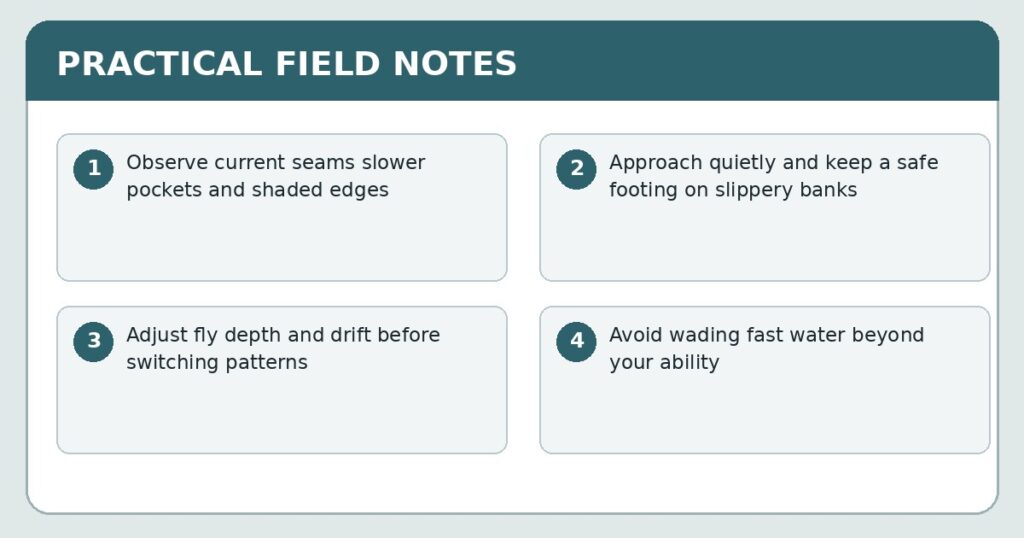
Adjust fly depth and drift before switching patterns
Adjust fly depth and drift before switching patterns. Avoid wading fast water beyond your ability. That second check makes reading river currents to find better fishing water more useful in practice, because it links a decision to evidence. It can also expose an overlooked constraint; record any cost, timing or compatibility issue before proceeding.
Before moving on, make sure you have the right resources and permissions. Two useful checks are: Adjust fly depth and drift before switching patterns. Avoid wading fast water beyond your ability. Stop if either requires skills or approvals you do not have.
A final safety and compatibility check
Avoid wading fast water beyond your ability. This step belongs in the reading river currents to find better fishing water decision, not as an afterthought. If you cannot complete it safely, pause and consult the applicable manufacturer guidance or a qualified professional.
Putting the advice to work
Consider someone who has just one afternoon for reading river currents to find better fishing water. A sensible starting sequence would be: Observe current seams slower pockets and shaded edges. Approach quietly and keep a safe footing on slippery banks. With those observations in hand, the next check is: Adjust fly depth and drift before switching patterns.
Frequently asked questions
What is the first thing to check for reading river currents to find better fishing water?
Observe current seams slower pockets and shaded edges. Approach quietly and keep a safe footing on slippery banks.
What tends to cause avoidable mistakes with reading river currents to find better fishing water?
Avoid wading fast water beyond your ability. Adjust fly depth and drift before switching patterns.
How can I judge whether the change is useful?
Try the following check and note what actually happens: Adjust fly depth and drift before switching patterns. Record the result and relevant conditions before making another change.
A quick reference before you finish
- Observe current seams slower pockets and shaded edges.
- Approach quietly and keep a safe footing on slippery banks.
- Adjust fly depth and drift before switching patterns.
- Avoid wading fast water beyond your ability.
Use the checklist for reading river currents to find better fishing water as a starting point, not a substitute for local requirements or qualified advice when risks are involved.