

Essential Fishing Knots and How to Practise Them
When working through essential fishing knots and how to practise them, it is useful to distinguish essential checks from optional improvements. Practise a reliable clinch or improved clinch knot. A little preparation can reveal whether the first solution is genuinely a good fit. This guide is aimed at readers in United States, where product specifications and local rules may differ.
Licences, species protection rules and river access differ across states and regions; check the responsible local authority. Check knots by pulling steadily before the first cast. Keep the next step practical enough to complete and record, even if the larger project will take longer.
Practise a reliable clinch or improved clinch knot
Practise a reliable clinch or improved clinch knot. For a practical comparison, complete this check: Check knots by pulling steadily before the first cast. Keep a short note of the result. A separate related action is: Replace abraded tippet after contact with rocks. Compare outcomes before changing the plan.
Compare alternatives using the same evidence. Record one result for: Practise a reliable clinch or improved clinch knot. Record another for: Check knots by pulling steadily before the first cast. That is more informative than comparing headline prices alone.
Check knots by pulling steadily before the first cast
Check knots by pulling steadily before the first cast. Before committing more time or money, check the next requirement: Replace abraded tippet after contact with rocks. For essential fishing knots and how to practise them, the aim is to avoid an unnecessary or incompatible choice. Keep a reversible option available when the evidence is incomplete.
If the first attempt does not help, check what changed. Revisit the steps separately: Check knots by pulling steadily before the first cast. Replace abraded tippet after contact with rocks. This prevents an unverified assumption from guiding another purchase.
Replace abraded tippet after contact with rocks
Replace abraded tippet after contact with rocks. Treat this as the initial filter for essential fishing knots and how to practise them. Avoid using frayed leaders that weaken suddenly. Rather than changing several things at once, note what you can verify after the first action. If the conditions differ from your assumptions, revise the plan before committing further.
This is intended as a repeatable process rather than a one-off trick. Start with: Replace abraded tippet after contact with rocks. Follow with: Avoid using frayed leaders that weaken suddenly. Review the outcome before adding more work.
A final safety and compatibility check
Avoid using frayed leaders that weaken suddenly. This step belongs in the essential fishing knots and how to practise them decision, not as an afterthought. If you cannot complete it safely, pause and consult the applicable manufacturer guidance or a qualified professional.
Putting the advice to work
Imagine comparing two options for essential fishing knots and how to practise them. Rather than picking the attractive option immediately, use these tests: Practise a reliable clinch or improved clinch knot. Replace abraded tippet after contact with rocks. If a relevant safety or compatibility issue remains, do not commit until it is resolved.
Frequently asked questions
What is the first thing to check for essential fishing knots and how to practise them?
Practise a reliable clinch or improved clinch knot. Check knots by pulling steadily before the first cast.
What tends to cause avoidable mistakes with essential fishing knots and how to practise them?
Avoid using frayed leaders that weaken suddenly. Replace abraded tippet after contact with rocks.
How can I judge whether the change is useful?
Try the following check and note what actually happens: Replace abraded tippet after contact with rocks. Record the result and relevant conditions before making another change.
A quick reference before you finish
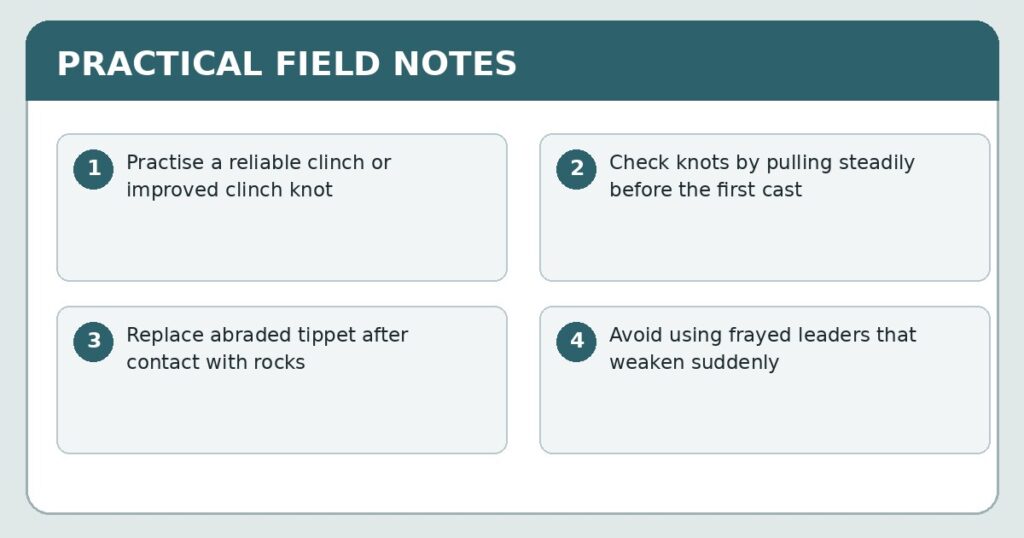
- Practise a reliable clinch or improved clinch knot.
- Check knots by pulling steadily before the first cast.
- Replace abraded tippet after contact with rocks.
- Avoid using frayed leaders that weaken suddenly.
Use the checklist for essential fishing knots and how to practise them as a starting point, not a substitute for local requirements or qualified advice when risks are involved.